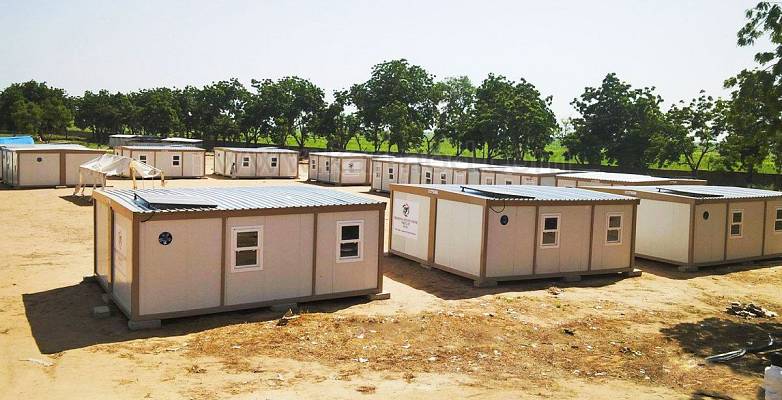

Outdoor workplaces require structures that can withstand regular use while providing an appropriate environment for employees and visitors. Security checkpoints, reception areas, ticketing facilities and industrial sites often need compact buildings that offer protection from weather conditions without occupying excessive space.
Traditional construction is not always the most practical option for these requirements. Organisations may need buildings that can be delivered efficiently, positioned within existing premises or relocated when operations change.
Prefabricated polyester cabins are among the modular solutions considered for these applications, particularly where compact dimensions and low-maintenance external surfaces are priorities.
Understanding Polyester Cabin Construction
Polyester cabins commonly use glass-reinforced plastic, also known as GRP, within their construction.
GRP combines a polymer resin with reinforcing glass fibres to create a composite material. Depending on its formulation and manufacturing process, the resulting structure can offer useful resistance to moisture, corrosion and general environmental exposure.
These characteristics make composite materials relevant to outdoor applications where surfaces are exposed to changing weather conditions.
Unlike conventional building materials, moulded composite components can also be produced in different shapes and finishes.
For organisations exploring durable polyester cabins for outdoor commercial use, the construction method provides an alternative worth considering alongside panel-based and other modular building systems.
The appropriate specification depends on the intended location, expected occupancy and required internal features.
Common Commercial and Industrial Applications
Polyester cabins can be used in environments where a compact enclosed facility is required.
Security personnel may need a designated position near a vehicle entrance or industrial access point. A suitable cabin can provide shelter while supporting routine monitoring activities.
Parking facilities are another potential application. Attendants responsible for supervising vehicle movements or assisting motorists may benefit from an enclosed workstation.
Commercial premises may require small reception or information facilities close to building entrances.
Ticketing areas, recreational sites and temporary operational locations can also benefit from compact modular accommodation.
Although the activities vary, the underlying requirement is similar: a practical working space that fits the available area and supports everyday responsibilities.
Why Material Selection Matters
Outdoor structures must cope with more than occasional rainfall.
Sunlight, moisture, temperature changes and regular cleaning can affect external surfaces over time.
Composite materials may offer advantages in environments where corrosion resistance and ease of maintenance are important. However, performance varies according to resin quality, protective coatings, manufacturing methods and exposure conditions.
Ultraviolet protection deserves attention because prolonged sunlight can affect some polymer materials.
The suitability of the structure should also be assessed against local wind loads and other environmental conditions.
Fire performance and relevant building regulations must be checked separately, as these cannot be determined simply from the term polyester.
Selecting an appropriate construction specification is therefore an important part of responsible procurement.
Creating Comfortable Internal Working Conditions
A durable external structure is only one element of a functional cabin.
Employees using the space regularly need suitable ventilation, lighting and temperature management.
Window positioning can influence visibility and natural light, particularly in security or parking applications.
Internal dimensions should allow sufficient room for seating, communication equipment and necessary operational materials.
Where electrical devices are required, safe installations and suitable power connections must be planned.
Door placement should also provide convenient access without interfering with pedestrian or vehicle routes.
These considerations help ensure that a compact building remains practical throughout normal working hours.
Evaluating Modular Cabin Options
When selecting a cabin, businesses should compare construction materials, dimensions, maintenance requirements and expected usage.
A lightweight structure may be suitable for one location, while another application may require greater insulation, additional internal space or enhanced security features.
Manufacturers such as Karmod offer different modular cabin configurations for commercial and operational environments.
Reviewing the available alternatives can help organisations choose accommodation that matches their site conditions and budget.
Supporting Long-Term Operational Flexibility
Polyester cabins can provide practical accommodation for businesses requiring compact outdoor facilities.
Their suitability comes from the relationship between material performance, thoughtful design and correct installation.
By considering these factors together, organisations can establish functional working environments that accommodate everyday activities while allowing flexibility as operational requirements develop.